|
| Too much?
Now that The Election is over, I can exhale. In the six weeks leading up to D Day, I gave in to all the anxiety-inducing reports about statistical dead heats and razor thin edges and nearly dissolved into a palpitating heart. It got so bad that I basically lost it on my sister when, during her Hurri-cation Sandy stay at my house (her power was out for a week), she insisted on listening to both sides and flipping between MSNBC and Fox.
It didn't help that I was working on a blog post for MadameNoire.com which I've been contributing a lot to lately, about an Election-themed exhibit happening simultaneously in seven museums across the country in which a portrait of Obama hung on a wall while Mitt Romney's photo waited on the floor, only to replace Obama's if he won. The idea of the Romney shot replacing Obama's picture gave me night sweats.
I can't remember ever feeling so invested in the outcome of an election though I'm not sure that's a good thing. Four years ago, I campaigned for Obama in Pennsylvania on two separate occasions and made phone calls to battleground states, but this time, oddly, his victory or defeat felt more personal. I genuinely believe in President Obama's core philosophy--I think Michelle Obama expressed it best when she said "When you've worked hard and done well, and walked through that doorway of opportunity, you do not slam it shut behind you. No, you reach back and you give other folks the same chances that helped you succeed."

Too loud?
I've never been the type of person to wear my affiliations on my sleeve. In fact, I've existed keeping mum about how I truly feel about a lot of things for most of my life, reserving expression of my feelings for the endless journals I've filled and my very closest family and friends. By nature I'm more of a watcher and a listener (good traits for a writer, I think), but over the last few years something's come over me. Lol.
One of the biggest dreams of my life came true in 2010 -- my first book was published -- and I had to open my mouth and sell it. I had to be persistent, unabashed, sometimes obnoxious to be heard. For example, the old school rapper Fab Five Freddy bought my book at the Harlem Book Fair two years ago just to shut me up, I think. After I went all Crazy Eddie on him, he said "Damn, girl!" plunked down his $15 and left me to his peace. I didn't know I had that in me until the book came out. Since the book has been out, I've had moments when I've had to tone it down or turn it up as I've discussed in my "Why Michelle Obama?" post and seek a balance as I posted in "The Writer's Prayer."
Originally, I thought the balance I was seeking had to do with self-promotion and work-life, but I now realize it's more about my desire to find the balance between how much to reveal about what I feel and who I am, and how much to keep for myself. In essence, what am I willing to wear on my chest. In advertising/marketing, promotional materials like branded t-shirts and the deck chairs pictured above are called collateral. An appropriate term considering collateral also refers to what you're willing to pledge/put on the line for some bigger debt you owe.
Anyway, I'm still figuring this out. I got more silent in the last year and a half figuring everyone within my immediate and extended social reach already knew about Powder Necklace and also because I was devoting more time to working on Book #2--but I was shocked to find that some of my friends still didn't know I had a book out. Funny, when you think you're being too loud, it turns out you aren't being loud enough.
|
Saturday, November 10, 2012
Collateral Damage?

Sunday, September 9, 2012
I'm in 'Time Out Accra'!

Wednesday, September 5, 2012
Ghana in 28 Days
I'm back
from a monthlong trip to Ghana which doubled as family time, an opportunity to
participate in homecoming activities at my high school, a chance to visit the OrphanAID Africa
Foster Family Center compound, and research for my next book project. I thought
for sure 28 days would be more than enough, but of course it wasn't.
I got to
Ghana a week after the abrupt and shocking death of the late President
John Evans Fiifi Attah Mills. The entire nation was in mourning.
News programs seemed to report only on the funeral preparations. (16 heads of
state/dignitaries were coming, including Hillary Clinton.) And in the two days
leading up to his August 10th burial, the entire nation was invited to file
past his glass-encased body in a public wake. Every other billboard that
lined the roads eulogized Mills as organizations and corporations publicly
expressed their grief and condolences. Everything was draped in the red and
black funeral colors reserved for royalty.
 |
different versions of Mills' funeral cloth
|
I always
learn something new about the culture when I visit Ghana, and via Mills'
funeral, I learned just how much fashion "speaks" in Ghana. Perhaps I
was just sensitive to it after reading Catherine E. McKinley's insightful memoir Indigo, which charts the significance
behind the designs of many African prints and cloth dyeing processes. To
commemorate Mills' death, several cloths were designed including different
versions of a State Cloth, and a Party Cloth meant for members of his political
party NDC. Being the fashion lover I am, I wanted to collect a few of the
cloths as keepsakes of the historic moment (Mills is the only Ghanaian
President to die in the middle of his term in office). But I couldn’t choose a cloth simply for
aesthetics.
The Party
Cloth, which bears the NDC insignia of a green, white, red, and black umbrella,
was banned from the actual funeral so as not to promote partisan politics at
the late President's funeral. (This is an election year in Ghana.) Of course
some people wore the NDC cloth anyway, but I went with an all black cloth
instead.
During
that first week of mourning, I traveled to my alma mater Mfantsiman Girls'
Secondary School to give a talk on creative writing as part of the Homecoming
festivities. Every time I make the journey from Accra to Saltpond, I am 12
years old again. My stomach drops and my armpits start leaking the moment the car
passes Mankessim, the market town less than 20 minutes' drive from the school.
I make the journey every single time I go to Ghana. It's a weird pilgrimage for
me.
Anyway,
when we got there, the first thing my mother and sister chorused was: "The
school looks so much better!" The fresh paint wasn't the half of it.
The current Headmistress presented a progress report that moved me to
tears. The PTA have donated 50 computers, and refurbished the computer lab.
There is a new classroom block, ostensibly so students don't have to have
class in outdoor huts anymore. The students no longer have to eat in shifts thanks to
the new dining hall the PTA built, big enough to accommodate the total school population. The '85 Year Group refurbished the Infirmary
and donated a tractor to the Agriculture Department. And the students are
snagging prizes and winning competitions left and right. I didn't check for
myself, but the students later told me, the water flows relatively
consistently.
A few
more reports followed with similar news of development as the Mfantsiman Old
Girls Association (MOGA) shared all the initiatives they planned to take up to
improve the Mfantsiman experience. And then I was up.
 |
| Mfantsiman Girls |
About 400
students who had stayed on campus to prepare for upcoming exams filed into the
pews of the chapel which doubles as the school assembly hall. I felt my mouth
go dry with nerves as I began to speak to the congregation. In the crowd, I could see myself
at 12, sandwiched between my friends, frenemies, tormentors; and very quickly, I
was crying. My mom started crying too. I saw some of my old school mates wiping
tears as well; one graciously offered me a tissue. This last gesture generated a chorus of
"AWWWWW!!"s from the girls. :-)
Once I
pulled myself together, I spoke about the importance of seizing our own
stories.
It was an
experience I will never forget.
I got to
travel around the country a bit.
A friend
took us on a tour of Tema Harbor, the port where the bulk of goods shipped to
Ghana passes through. Stupidly/glamorously, I wore heels, but, thankfully, I was able to
maneuver the rocky gangplank without a tumble. Along the way we discovered a
community of (cute!) rastas living in makeshift houseboats.
We later
went to this amazing village called Nzulezo that literally hovers over a river--it's
built on stilts! It was a six hour drive from Accra, then an hour canoe ride to
the actual village, but it was worth it. The village of 450 men, women, and
children are used to being ogled all day every day by visitors so they are
prepared. The children greeted us at the canoe drop with post cards for sale, and
when they saw no one was interested, they started dancing for money. I had this
gross conflicted feeling watching these children--toddlers really--perform for
cash. They were too young to be transacting for money. But I watched, riveted,
and handed a few cedis over anyway because they were so damn good at the
azonto, a dance craze that has totally taken over the nation. Right after they
got their money, the smiles and dances were gone as the kids completely ignored
us. It was funny and chilling at the same time.
 |
| in Ada, we stumbled across this mural |
We drove
to a beach town called Ada Foah. This time the drive was only two hours' long.
The beach, which is bordered by the rolling waves of the Atlantic Ocean on one
side and the peacefully still Volta Estuary on the other, was so gorgeous--even if a lot of it
was littered with garbage. We walked for hours, passing the odd goat, fisherman,
villager, and backpacking tourist.
Three days before I left Ghana, I visited the OrphanAID Africa Foster Family Center compound. Sitting on five acres of land in a small town called Ayeniyah, an hour's drive from Accra, it is an amazing eco village built to educate, house, and treat abandoned and special needs kids. I was so moved by the dedication of the founder Lisa Lovatt-Smith and staff members, and the thoroughness of the planning.
They have
solar powered energy, trees that support the houses as beams.
They collect and use "grey water" for washing to conserve the
drinking water supply. They have a farm with plots for each family; and a physical
therapy center for the special needs kids that is outfitted with exercise
equipment and wheelchairs. They also have a library that needs books. You can post
books to:
OrphanAID
Africa
PO Box
DD61
Dodowa,
Dangme West, Greater Accra
Ghana,
West Africa
You can
also donate here.
 |
| The OrphanAID Africa Library |
I read a
short passage from Powder Necklace to a group of the OA high schoolers and
shared a bit about my experience attending Mfantsiman. In the Q&A that
followed, one of the kids asked me what legacy I want to leave on earth. After
seeing all that Lisa has been able to accomplish in the 10 years she's been in
Ghana, I lumbered under that question. Creating a body of writing that blesses
people seems so inadequate.
But it's
what I got, and I intend to use it. Throughout my trip, I wrote and have the
beginnings of three projects to keep myself busy, in addition to my second
book. I can't wait to share them all with you.
Monday, July 30, 2012
2012 BID Fellowship in Brasil: Part 3
 |
| church in Pelourinho square |
 |
| dancers perform Capoeira at Bale Folklorico |
I had heard/read Brasil has the most Africans outside of Africa before I went to Bahia, but it was warming and shocking all the same to
see exactly what that means, live and direct. Salvador’s landscape, simmering heat, and energy
mirrored Ghana’s to me: The red dirt roads, the various stages of construction
happening everywhere, the gated communities of mini mansions tucked behind high
walls, the cucumber-cool supermarkets stocked with pricey provisions, the
Buddha-shaped women wrapped and knotted in African cloth selling smoking street
food…
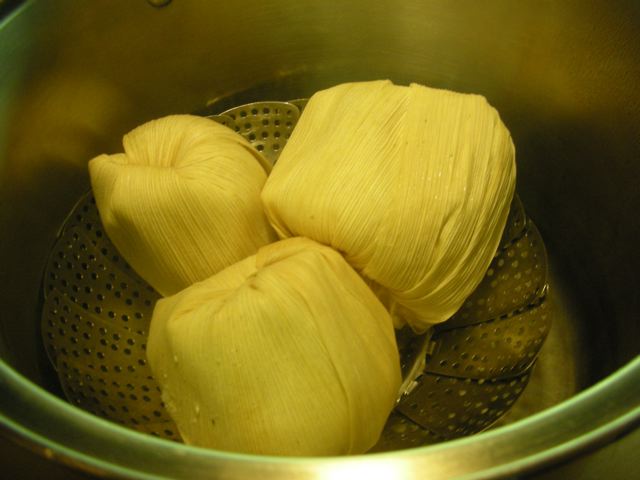
The food in particular was a comfort to me. I recognized kose (they call it acaraje); a sweet fermented corn dough snack wrapped in corn husks that looked like kenkey, and bankye aka boiled cassava which they served at our hotel for breakfast one morning.
The food in particular was a comfort to me. I recognized kose (they call it acaraje); a sweet fermented corn dough snack wrapped in corn husks that looked like kenkey, and bankye aka boiled cassava which they served at our hotel for breakfast one morning.
 |
| an acaraje stand in itapua, bahia |
And then there was the religion.
On our first Wednesday trip to Pelourinho, we were apprised
that many in the square who had donned red were doing so in observance of Santa Barbara day,
Santa Barbara being an African orixa or god worshipped in Candomble, an African
traditional religion practiced in Brasil.
That evening, we saw a procession of men robed in red African apparel,
some in masks, drumming in the Pelourinho square. On a Friday trip to the city center, we were
told that many would be wearing white in honor of another African goddess called
Oshun. As we rode around town, I noticed businesses named after Yemanja, a
goddess of the river; and pedestrians wearing t-shirts/baseball caps hanging in
the market celebrating an Olodum Festival. (The Olodum Festival is not religious; Olodumare is the name of God in Yoruba)
The professor and poet Joao who came to visit us when we were staying in the Bahian 'burbs as part of a small welcoming committee of Brasilian writers, poets, and culture-keepers, so graciously took time out of
his schedule to take us on a walking tour through his hometown, the historic
city of Cachoeira. Cachoeira is known for its committed practice of Candomble.
He took us to a building in honor of the Sisterhood of the Good Death, a secret
society of African women 40 and above who did side work on top of their duties
as enslaved captives to buy their freedom and that of others in the community.
Joao explained that there had been some opposition to the building by one
Catholic priest in the town, but in the end the memory of these women had been
preserved by the author Jorge Amado who had been an advocate of preserving
Brasil’s African culture. Later that day, Joao took us to a traditional African
religious terreira or temple.
Having grown up partially in Ghana, in a Christian home, and
being Christian myself, my spirit roiled with discomfort and I felt an inner
warning shot fire. In Ghana, as in many countries outside of the West, things
of the spirit are not taken lightly. Religious temples, ceremonies, and
practices are not casual cultural tour stops, but portals to spiritual realms;
and I did not want to invite or entertain any unfamiliar spirit(s).
But having been an Africana Studies major in college, and
specifically having taken a course in the Sociology of Black Religion, I was and am well aware of the role religion—particularly Christianity—played in the
enslavement, manipulation, and liberation of African people. While legislators,
enslavers, and others who directly and indirectly benefited from the free labor
force and subjugation of African men and women advanced the Society of the Propagation of the Gospel’s mission to enter “foreign parts", Christianize
the African and Indian "heathen” and "savages", and effectively erase all connections to their native culture via
language, religion, music, etc; Christian Abolitionists were calling out the hypocrisy and sheer evil of the
institution of slavery and fighting for its end.
Meanwhile, the ancestors of black liberation theology were at work. While many
enslaved Africans got the explicit and subliminal message that life would be
easier for them with respect to their interactions with the enslavers if they
converted to Christianity, many of the forced African emigrés
used the slavers’ religion as a cover to preserve and practice their
traditional African religions, and/or communicate messages plotting escape from
enslavers. In America, Harriet Tubman used Negro spirituals to direct Underground Railroad missions; and later it was no coincidence that the black
church in America was a hub of the Civil Rights movement. In Latin America,
Santeria and Candomble were examples of how the Africans who were enslaved used
the Catholic church’s worship of saints as a cover to worship orixas, or merged the religious traditions into one belief system.
I respect the fact that many Afro-Brasilians so fiercely held
onto their beliefs under threat of violence and extinction, and was so moved by the powerful story of the Sisters of the Good Death. The image of
these women coming together to subvert the twisted system that kidnapped them
from their homes and ripped them from their families by devising the means to buy their freedom and that of others in their community is just rockstar to me—while the converse of the town Catholic
priest rallying against them is yawn-inducing.
Now “Good Death”, Joao explained, signifies the African
outlook on death not as a bad thing, but a continuation of another realm of
life. As a Christian and African, this resonated with me because I believe
Jesus’s death was a good thing—the liberation of mankind from the sin that
separates us from God—and his resurrection was the continuation of that good
thing; the promise of eternal life to come for those that believe in him. That
said, it struck me, as a Christian, how the religion has been used to
manipulate African people into docility. As Joao shared the story of the Good
Death Sisters, I wondered what I would have done in their situation. Would I
have subverted, or would I have gone along with the okiedoke in the name of
Jesus, afraid to rock the boat?
I asked myself this question in another way when we went to
the Bale Folklorico in Pelourinho. As I watched the men perform the spiritual fight dance of
capoeira, flipping and flinging themselves across the stage with acrobatic
precision and balletic grace, I wondered why my spiritual guard was down. I also
played back the museum visits we had made in Bahia, ambling past religious
masks and other artifacts. Why was I comfortable seeing these religious
performances and artifacts in environments sanctioned by whites as cultural institutions,
and not in their natural environments?
It hit me after the Bale Folklorico just how much had been
lost in the trade of human beings as slaves—how much Africa and her culture has
been mythologized on both sides with whites dismissing African practice as
heathen, pagan, savagery; and the Diaspora so fiercely protecting and preserving
it that in some cases Africans journey to Brasil and other African enclaves in
the Diaspora to study the indigenous way. Meanwhile, many Africans take it all
for granted, even as African culture—as with all cultures—evolves.
Perhaps because Africans who remained on the continent did not feel the need to preserve the culture as much as those who were forcibly removed did, many contemporary Africans make the free choice to observe Christianity and Islam and other religions. I should add that not every Brasilian I encountered was a practitioner of Candomble. I learned later that some of the students that joined us on the tour of Cachoeira opted not to go inside the terreira because they are evangelical Christians. I also saw several Assemblies of God churches as we drove around town. I'm sure, as with every society, there are also many Brasilians of other faiths as well as agnostics and atheists. I should also add that in the narrative of Christianity, one major truth gets left out that one of the oldest Christian churches was founded in Ethiopia in the 1st century, pre-dating the transatlantic slave trade and colonialism as we know it.
Spirituality and religion at their purest expression and
practice come down to faith. What you believe is definitely molded by the value
system you were raised with as a child as well as the experiences you have as
you mature into adulthood. At some point, every adult makes the determination
for herself or himself to continue in the faith, or lack thereof, they were
brought up with, or abandon it for something else. That decision can be clouded
by race, ethnicity, and history, but again, in its purest form faith and what
you choose to believe has nothing to do with external things. It’s an internal
choice that then, ideally, finds its expression in our action.
What does any of this have to do with my adventures as a writer? Well, I think it
necessary to hash these
things out as best I can for myself, so I can write with deeper honesty and
integrity.
If you haven't already, check out Part 1 and Part 2 of my experiences as a 2012 BID Fellow. Thank you for reading!
Friday, July 20, 2012
2012 BID Fellowship in Brasil: Part 1

Back in May 2010, I went on my first out-of-state trip to promote Powder Necklace at the Afr'Am Festival in Norfolk, VA. I set-up my books in the Literary Cafe unsure of what else to do as I watched the other authors get their hustle on. They hawked their books calling passersby to stop by their tables, dispatching friends and children to hand out bookmarks and other marketing collateral, and explaining their stories on the different panels.
I was incredibly intimidated. I had my big box of books, and I was wearing a cute dress, but I was not prepared. Everyone was gracious to me, but as they peppered me with questions about my plans to market myself and the book, it was clear I was a rookie. One of the writers I met that day was Tinesha Davis, author of Holler at the Moon. She was incredibly supportive and so generous with her story, and information and suggestions about what I could do to get the word out about my book.
A few weeks later, she came to New York to do a joint reading at Hue-Man bookstore in Harlem with authors Kwame Alexander and Victoria Christopher Murray. After the reading, several of us went to dinner. That evening, I learned from Kwame that he was producing the Capital Bookfest. I sank my teeth in as it were, rabidly pitching myself for the opportunity to attend, and he graciously invited me. Over the next six months, I had the opportunity to sell my books and speak on panels in the three cities the Capital Bookfest hosted dates. It was the opportunity of a lifetime, and I will be forever grateful to Tinesha, Kwame, and God for connecting me with both. I really think of them as angels to my literary career.
But fast-forward to Brasil.
I knew Kwame had launched an international fellows program two years ago. We had become Facebook friends and I "liked" all the posts that popped up in my newsfeed that he and Tinesha shared of their time in Tuscany. I never imagined that two years later, I would be invited to the second international fellowship in Brasil!
As the date for my flight approached, I kept fearing something would go wrong because I wanted it so badly; so when we were stopped by American Airlines officials on our way to board the connecting light from Miami to Salvador, I felt my armpits begin to puddle. Half of our group was on the plane, and the other half of us had been held back. We waited a half hour with no explanation as the AA folks called border patrol. Finally, we were told we could board.
When we got on the plane, one of the flight attendants announced the plane was 5000 pounds overweight. My fellow Fellows must have seen my panic because they all graciously came to visit me where I sat in the booty of the plane--literally the last row on the aircraft where I could feel every cough and wheeze of the engine. One of the fellows, acclaimed novelist Tayari Jones, came by to share stories of the craziness that was happening in First Class. One guy was apparently waving cash demanding to be let off the flight.
Anyway, we made it to Salvador after a detour in Puerto Rico to replace the fuel they had dumped to lighten the plane, and it was beautiful. In between get-to-know chit chat with the other Fellows, I stole glances at the panorama whizzing past my window. Later, I was able to process the Bahian vibe and put it into a picture I could understand: it was Ghana x Cali, if that makes any sense. The kiosks, roadside food stands, omnipresent construction, and red clay of Ghana with the omnipresent pounding surf and foaming waves of Surftown USA.
We were staying in a house in a posh suburb of Bahia, called Barro do Jacuipe, a five minute walk to the beach. After unloading our stuff, we headed to the beach to make official intros, share a bit about the projects we planned to work on, and learn about the structure of the Fellowship. The itinerary would include education trips into the city of Bahia along with two free travel days. Aside from one meal a day that we were to enjoy in communal company, we were free to work on the projects we had come to the Fellowship to work on.
Those first few days we wrote and ate and talked into the night (swatting mosquitoes and flies) and respectfully passed around the Vivo internet stick so we could get on the interwebs. One Fellow, prolific author and poet Leslea Newman led a wonderful workshop on formal poetry. (Leslea and I also got wicked lost on a beach walk gone horribly awry.)
The Secretaria da Cultura do Estado da Bahia so generously availed themselves. They organized an evening of exchange between us and Bahian writers, poets, and culture-keepers. They read and sang, and we spoke through the patient translation of one of the officials at the Secretaria over Abara and other treats they brought to our home.
The Secrataria also helped organize a trip into the historic city of Pelourinho for us where we learned that the plaza used to be a popular square for those who enslaved to alternately show off and punish the human beings they enslaved. Pelourinho was also the site where the Afro-Brasilians revolted against colonial rule. Their revolution preceded the independence of all of Brasil, our guide explained. In Pelourinho, we also stumbled upon the foundation for Brasilian writer Jorge Amado. His books looked so amazing, but alas they were completely unaffordable as the taxes on books in Brasil are out of control!
On another day, we drove to the historic city of Cachoeira where Joao, a professor and poet, guided us though the town sharing nuggets of history about the Sisterhood of the Good Death, an order of African women who were enslaved that bought their freedom through side work (doing laundry, making cakes, etc) and ultimately bought the freedom of many others. We also visited a terreira or African temple in the hills of the city and learned a bit about the orixas (African gods) and the Candomble religion which has preserved much of the traditional African religious practices. It was a powerful and conflicted moment for me as a Christian which I'll get into in another (long) blog post. The picture above was taken in Cachoeira.
Later shit happened. One of the bathrooms in the house overflowed and we were forced to pack up abruptly. Kwame and Deanna who helped Kwame organize the trip were amazing at putting the alternative plan together so quickly.
We ended up in a sweet hotel on the beach in Itapua where we spent the rest of our time. Communal dinners continued poolside at the hotel or at the local churrasco, and in between, we scattered around the hotel to write.
I got some writing done, but I think in the end, the greater value of the trip was in meeting the people and getting exposed to the culture. I know I'll see the fellowship's impact in my future work.
Read more about the Fellowship in Part 2
2012 BID Fellowship in Brasil: Part 2
One of the most amazing things about the BID Fellowship experience for me, was learning from and sharing with Bahian poets, writers, and culture-keepers. Thanks to the amazing folks at the Secretaria da Cultura do Estado da Bahia, we had the unique opportunity to visit the home of legendary poet Jose Carlos Limeira. Mr. Limeira gave us a comprehensive review of Bahian culture past and present and then, generously, invited us to present.
 |
| Kwame reading one of his poems in Jose Carlos Limeira's living room |
Kwame Alexander who founded the BID Fellowship gave a powerful talk on the resistance tradition of African-American culture with specific focus on song and literature. He spoke accompanied by poets and BID Fellows Deanna Nikaido and Maritza Riveira, and BID Fellow, Teacher, and Musician Randy Preston who helped illustrate his points about how Negro Spirituals and literature were used to communicate messages among our mothers, fathers, uncles, and aunties who had to endure slavery, and later by the likes of Langston Hughes, Zora Neale Hurston, etc who powerfully documented the black experience in the Harlem Renaissance. He went on to reference the works of J. California Cooper, Nikki Giovanni, Toni Morrison, and others who continued the activist tradition of black literature, ultimately gaining the attention of the publishing industry.
BID Fellow Chris Colderley, a sharp poet and English teacher, followed with a thoroughly persuasive presentation on why students need to be taught poetry in schools. He spoke of not only the ability of poetry to help students build facility with written and vocal expression, but of poetry's power to transform the way we look at the world. Of course, we were all sold.
I jumped in here to give a personal talk about how I came to write African stories. Here's a transcript of what I shared below. It's long so I won't be offended if you read it in sips.
 |
| Poets Jose Carlos Limeira & Livia Natalia |
"I came to love African Literature by way of African-American
literature. Conveniently—and controversially—corralled into the black book
section of my bookstore (and on my big sister’s bookshelf), I discovered April
Sinclair’s Coffee Will Make You Black,
Bebe Moore Campbell’s Your Blues Ain’t Like Mine, James Baldwin’s Just Above My Head, Gloria Naylor’s The Women of Brewster Place, Toni Morrison’s Tar Baby, Alice Walker’s The Color Purple,
Maya Angelou’s All God’s Children Need Travelling Shoes, and so many others.
These books became my gateway to the works of other black
authors who weren’t American. By way of black book anthologies, I found Antiguan
writer Jamaica Kincaid, and through stellar word of mouth I picked up Haitian
author Edwidge Danticat’s Breath, Eyes, Memory and Krik Krak, for example. Some referenced Africa explicitly—like
The Color Purple, All God’s Children or Lorraine Hansberry’s
play A Raisin in the Sun—while others
told stories that I saw shadows of my African story in.
Whether exploring the complexities of the black immigrant
experience or the unique dynamic between Africans and African-Americans, or the
particulars of being a woman, these books each offered me a distinct mirror. It
was liberating to see myself, albeit slightly refracted, on these pages; and so
I moved on to African literature.
Now, before I discuss the African books that inspired me, I
think it bears explaining that growing up in New York as the daughter of
Ghanaian immigrants, my definition of blackness was shaped by African-American
culture. My parents had grown up in
Ghana and had experienced the downsides of colonialism, neo-colonialism, and
racism, but their identities were not carved by race. Their priority was to get
an education, make money, and send it back home. Everything was about “back
home” for them. There was always an exit plan—a place they would escape to.
But for me, “home” was our working-class neighborhood in
Queens, New York. My friends were the children of immigrants from Panama, Jamaica,
Trinidad, and Haiti, and families who had moved to New York from the South. We children
came from other places, but we were New Yorkers. And to prove it, we made fun
of anything that threatened that identity. I made fun of Haitians.
African-Americans made fun of me calling me “African booty scratcher.” Etcetera.
It didn’t help that the Ethiopian famine was in heavy
rotation on the news in the early ‘80s. The images of African children covered
in flies, their bellies bloated with malnutrition, made me cringe. If that was
Africa, I wanted no part of it.
So, in 1990, when my parents took us to Ghana for vacation,
my American identity firmly in place, I entered the country feeling superior to,
and amused by, all that was “different.” I did not know that my parents had
planned that vacation to be a permanent one.
Stuck in Ghana, and now enrolled in a boarding school two
hours’ drive from my relatives’ home in Accra, I was forced to confront why it
was that I felt better than those born in Ghana. I had to start examining why
it was that in Africa, water, electricity, paved roads, and other things I had
come to take for granted like cookies and soda and dessert were luxuries.
I was only 15, when I graduated from secondary school in
Ghana and returned to the States, so I won’t pretend to have become Kwame
Nkrumah. I was relieved to be back in the land of creature comforts, but,
still, my perspective on who I was and where I came from had changed—expanded.
I had become proud of my expanded story and wanted to share
it; so once again I looked to the African-American experience for help finding
my voice. As an Africana Studies and Political Science major in college, I was
inspired by the African-American political movement and sparked to find that
Ghana’s first president Kwame Nkrumah also got his training from the burgeoning
Civil Rights movement, using it to lead Ghana to Independence. In March 1957,
Martin Luther King, Jr and his wife Coretta Scott King attended Ghana’s
inaugural Independence Day celebration—at the personal invitation of Kwame
Nkrumah himself.
In secondary school in Ghana, we read Ghanaian poet and
author Ama Ata Aidoo’s Dilemma of a Ghost
and South African author Peter Abrams’ Mine Boy, among others; but it was a few years after college, that I started to
read African literature for pleasure. Chinua Achebe’s Things Fall Apart and A Man of the People. Buchi Emecheta’s The Joys of Motherhood and The Bride Price. Chimamanda Adichie’s Purple Hibiscus and Half of a Yellow Sun.
Ayesha Haruna Attah’s Harmattan Rain.
Instantly familiar, these books were the closing of the
circle for me, helping fill in the gaps from a historical perspective as to why
millions of Africans fled their native countries in the ‘70s, ‘80s and ‘90s—my
parents among them. They spoke of post-Independence struggles, war, gender, and
life. Kids going to school. Parents
going to work. Couples making love. This was the Africa I had experienced in
all its dichotomies, and it was the Africa I wanted to write about.
It was during this period that I started to write what would
become my first novel, Powder Necklace—an
African story by way of London and New York.
The African story is global.
We know that the African experience is not restricted to tales
of village life, or the impact of colonialism or neocolonialism, or immigration.
Should African stories, by necessity, be about protagonists living in Africa,
or do stories about African protagonists qualify—no matter where they may
reside? Or does it come down to the author’s nationality? For example, is white
British author Chris Cleave’s book Little Bee about a Nigerian girl in England as African as Nigerian author
Chimamanda Adichie’s Half of a Yellow Sun?
In Brasil, for example, which has the largest population of
African descendants outside of Africa; where Acaraje stands sell treats from
Nigeria, and traditional African religions are the cultural norm, how do we
classify the works of writers like Jorge Amado, Damaris Cruz, or Maria Firmina dos Reis and Machado de Assis?
The African story starts on the continent of Africa, but it
has literally travelled around the world—just like the African people. It is a
story that has birthed so many other stories—and that needs to be acknowledged
and embraced. Chimamanda Adichie poignantly spoke about the danger of the single story, particularly as it
relates to the African story, and I wholeheartedly agree.
The current and next generations of literature students and
teachers need to understand the connections between African literature and literary
works from other continents; and grasp the influence Africa has had on global
literature. African literature—black literature—needs to be talked about, handled,
and appreciated, in its fullest context.
But first, we the people need to understand and appreciate
ourselves in our fullest context. We’ll need to stop thinking of ourselves as a
minority, when in fact, people of African descent are a global majority. Once
and for all, we need to know with all confidence that our story—in all its origins
and permutations—is worth telling. Because it is."
Wednesday, June 13, 2012
Have a Voice!!!
by Donnice Peterson
 When I first started nurturing my love for writing I struggled to find my voice within my work. I had this misconception that there was a certain way a "writer" is supposed sound. I thought writers had to use big words, be totally unbiased yet somewhat humorous, and be the ultimate authority on their topic. This may be true in a sense, but ultimately a writer must sound like herself.
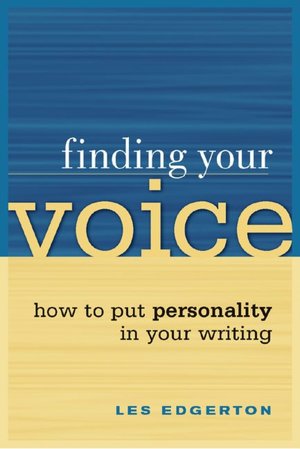
Les Edgerton the author of Finding Your Voice: How to Put Personality in Your Writing says: "Don’t write to impress, fellow scribes. Write to connect with your readers. Your writer’s voice builds a better bridge to your readers. It’s your fingerprint, it’s your individual writing style, and it gives your writing soul".
Edgarton's advice spoke volumes to me. For one thing, it made writing much less daunting. Trying so hard to sound like someone else made me less confident in my work because I never felt like I was getting it right. Gratefully, one of my mentors brought to my attention that my writing had great potential, but she could not identify my voice. She told me the more my writing sounded like me the more my reader could grow to love my work. I realized that I wanted my readers to pick up one of my pieces and instantly say, this sounds like Donnice without even looking at my byline.
Your voice is what builds your brand. Your voice is what makes your readers fall in love--or not--with your work. In my work, you will hear a goofy, sarcastic, passionate young lady who is hungry for a prosperous future without any reservation--that's my voice. What's your voice?
 When I first started nurturing my love for writing I struggled to find my voice within my work. I had this misconception that there was a certain way a "writer" is supposed sound. I thought writers had to use big words, be totally unbiased yet somewhat humorous, and be the ultimate authority on their topic. This may be true in a sense, but ultimately a writer must sound like herself.
Les Edgerton the author of Finding Your Voice: How to Put Personality in Your Writing says: "Don’t write to impress, fellow scribes. Write to connect with your readers. Your writer’s voice builds a better bridge to your readers. It’s your fingerprint, it’s your individual writing style, and it gives your writing soul".
Edgarton's advice spoke volumes to me. For one thing, it made writing much less daunting. Trying so hard to sound like someone else made me less confident in my work because I never felt like I was getting it right. Gratefully, one of my mentors brought to my attention that my writing had great potential, but she could not identify my voice. She told me the more my writing sounded like me the more my reader could grow to love my work. I realized that I wanted my readers to pick up one of my pieces and instantly say, this sounds like Donnice without even looking at my byline.
Your voice is what builds your brand. Your voice is what makes your readers fall in love--or not--with your work. In my work, you will hear a goofy, sarcastic, passionate young lady who is hungry for a prosperous future without any reservation--that's my voice. What's your voice?
Subscribe to:
Posts (Atom)